Saturday, July 12, 2014

Driving in Malawi

Driving in Malawi is pretty different from driving in any other place in the world. In Malawi, you normally don't worry so much about the other cars - I've been driving for more than an hour on the main roads without meeting any other car. Here, there are other obstacles: Bicycles, people, goats, chicken, kids, dogs, roadblocks, police, potholes, and tarmac crumbling away from the edges of the road.

The few other cars on the road though normally choose between two different driving styles: Insanely slow or insanely insane. I think I have never driven before or behind any other car for a longer period of time, here everybody choose their own speed, so it's about overtaking or being overtaken. The most scary is to drive at night - africans are hard to see in the dark, roads are narrow and when a 100-ton truck comes towards you with blinding lights at 100 km/h - the road is 4 m wide and the shoulder of the road is a crumbled precipice of 0.5 m you wish you would have started off earlier. So we try to avoid driving at night as much as we can.

Below is a video I took last weekend while driving through Dwangwa, a town some 50 km north of Nkhotakota. That gives an impression of how it can be.


Another interesting thing about driving in Malawi is that, as I have understood, the international drivers licence is only valid for two months after your arrival to the country. However, to get a Malawian drivers licence you need to have a residence permit. A recidence permit can be applied to after three months, and the processing will take another three months. Or more. We applied for the residence permit in April, and now by mid July we have still not heard anything about that. So, you just have to talk your way out of it when being stopped by the traffic police when they ask about the drivers licence. And the traffic police will stop you...

Thursday, July 10, 2014

Testing testing

*Nerd alert*

When I came to Malawi, I repeatedly experienced people talking about the problem of low-quality products on the market for solar lights and solar energy in general. Innocent as I were at that time, I assumed that it could not be so bad. Everywhere you find low-quality products, but the good thing is that they are cheaper, so in the end it might be adviseable to buy the low-quality product.

To have power in a house in the middle of nowhere in Malawi, you need basically two things: A solar panel and a battery (+ some more things, but let's keep it simple). Before I came to Malawi, I assumed that this world was straight forward - a solar panel is a solar panel, and a battery is a battery. To make life even easier, the solar panels and batteries have numbers on them that tell how much power they can produce or how much energy they can store.

How to power your offgrid home in Malawi...

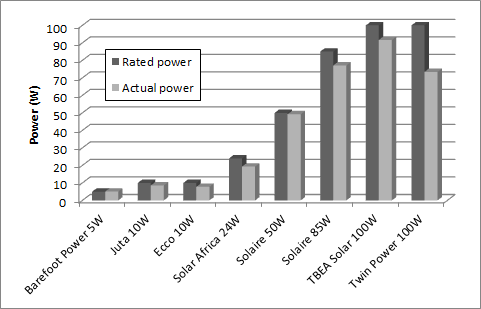
Anyway, I went to my new existence in Malawi carrying my experimentalist background, and soon started to test different solar panels to see if they performed well. I just did simple measurements with a general multimeter and the sun as the light source, and I soon discovered that the power of the solar panel that was written on the back of it not always was in agreement with the actual power. I acknowledge that my measurements were not 100% accurate, but with some reasonable assumptions and simplifications, I found that the power of some of the panels was as low as 70% of the rated power. I imagine it would be difficult to sell Coca-Cola bottles that are 70% full, but with solar panels it's not so straight forward to see, so they sell anyway. 

Performance of a few selected panel sizes and brands available in Malawi.

I knew quite a bit about solar panels before getting here, but not as much about batteries. Since I did not know so much, I was even more naive about the batteries. It took me a while before my experimentalist drive made me also start testing batteries. That was, however, even more shocking. Many of the batteries appeared to have a capacity of only 30% of what was claimed on the information printed on them. I could not believe my own measurements, but after spending a few weekends recording battery voltages every hour I was quite sure about what I had found. No-one would ever go back to a gas station that filled your tank 30% up and charged you for full tank? But since almost no-one ever bother to measure the capacity of a battery, people are beeing ripped off every day like this.

Actual battery capacity for a few different brands of small household batteries available in Malawi. The ones that perform well are hard to find...

Battery discharging: voltage as a function of time when discharging small household batteries at a current of 0.32A. The battery is empty at 11.5V - after less than five hours for the worst batteries, whereas the best can last for about twenty.

It seems that products that have failed quality control or something are the products that reach Malawi. The prices are low, but not low enough to justify the performance.

Simple tools in my improvised lab - but much can be done with a multimeter and a few bulbs!

I am also testing solar light bulbs for battery operation. The salespeople in the shops are totally amazed when I come with my multimeter to test the actual power consumption of the bulbs they are selling, and look at me as if I was a sort of magician. Last time I was checking I found that a certain bulb was rated 3W according to the box, on the bulb itself it was written 1W, but measuring I found that the power consumption was actually 8W.

If anyone interested solar energy in Malawi ever reads this, take note: Be very careful when you purchase products, especially batteries. The brand ECCO is the worst, but unfortunately also the most popular - it is the cheapest. 

Saturday, June 14, 2014

Sustainable Malawi

Last weekend I had the interesting experience of meeting a group of the volunteers of the American Peace Corps who work with environmental issues in Malawi. One of them was especially outspoken, and I had an inspiring conversation with him. For the sake of the story let's give him a random American name, let's call him "Bob". Here is a summary of the conversation:

"Bob": I don't like to take the word "rape" in my mouth, but some times you have to.
Trygve: What do you mean?
"Bob": Hey man, we are raping this planet. We are raping the nature.
Trygve: Yeah, I guess I would agree with that. What are you thinking about specifically?
"Bob": These Malawians, they are cutting down the trees, fishing all the fish, illegally burned charcoal is everywhere... You should see the mountains where I live in the dry season, they are on fire! They hunt animals by burning down their habitats, and they fish the even the smallest fish using mosquito nets to catch them.
Trygve: Yeah, that sounds bad.
"Bob": YES! They are raping the nature. However, I hope this new president can make a change to that.
Trygve & "Bob": Bla bla bla about Malawian politics and politicians.

...after a while....

Trygve: But "Bob", I think it is not only the Malawians who are raping the planet. How about the way people live for example back in America?
"Bob": What do you mean?
Trygve: Well it might be that your forests are more protected and you are not fishing with mosquito nets, but I mean, the American lifestyle has some impact on the planet as well, dosn't it?
"Bob": Yeah, it might have...
Trygve: I mean, all the things you consume over there, they come from somewhere, don't they? If all people would live like Americans we would be completely fucked up, would we not?
"Bob": Ehhhm.... OK.... (Screaming) Who wants some Jack Daniels?!?!?!

So that did not compute for "Bob". But I would say Malawi is actually one of the most sustainable societies I have seen. Let me give some examples:
- Food is produced and consumed locally.
- Bicycles and walking are the main forms of transport.
- I would guess less than 1% of the population has a car.
- As good as no-one ever uses airplane transport.
- Most malawians eat vegeterian food most of the time.
- (Almost) all garbage is recycled or reused and put to use locally.
- Almost all energy use is renewable: Electricity comes from hydropower and bioenergy is used for cooking.
- Houses are constructed using local materials and the houses are relatively small.
- Almost no energy is used for heating or airconditioning of houses and offices.
- Most people use second-hand clothes and other second-hand consumer items.

The most non-sustainable about Malawi I would say is the overpopulation and the continued high population growth, which explains the observations that my friend "Bob" had made.

Of course, my own observations can be traced back to the fact that Malawi is a very poor country. But anyway, the Malawian lifestyle is so sustainable! If everybody lived like Malawians we would probably be able to fit about 100 billion people on this planet without over-consuming.

Personally I do hope that Malawi can develop their economy without leaving this sustainable way of life. And I hope that Malawi can inspire the rest of the world to adapt their lifestyles more to live like they do. But unfortunately, it is not too popular to live as a poor person.

Being poor is not something people strive for, typically, but let me mention a last self-observed indicatior of sustainability in Malawi:
- Malawians are the happiest people I have ever seen anywhere in the world.

There are still some forests in Malawi, but all seem to agree that deforestation is a serious problem.
These nets are used for fishing at the lakeshore. Nothing but water is filtered through!
Small fish left to dry in the sun.
Transport of bioenergy with bicycle power! A common sight in Malawi.
Happy small fishermen with their catch of the day.
Rice is grown and consumed at the lake shore of Malawi - some is also exported.
Most people live in small houses constructed of locally found materials.The bricks are made from the clay soil that is readily available almost anywhere.
Transport of locally produced food - on a bicycle of course.
Malawian kids - so many - and so happy. No need for Toys'r'us, Lego or videogames, just hanging out with your friends and family in the village all day, and perhaps improvising a ball or a toy car from some garbage. Low carbon footprint kids!

Tuesday, May 20, 2014

Elections in Malawi

Today is the day of the elections of Malawi. We have been awaiting this day for a long time. Millions of dollars have been spent on the campaigns, tons of freebies have been given away, presidential candidates have been riding around on trucks filled with people screaming over loud music for days on end, and thousands of supporters of the parties have been paid on a daily basis to be extra supportive. Even so, the last few days have been surprisingly quiet, at least here in Nkhotakota.

There have been a few polls prior to the elections, but they have been showing a different result every time so nobody really knows how it will turn out. There are four candidates that seem to have a chance. The most probable seems to be the current president, Dr Joyce Banda. She was vice president when the last president passed away about two years ago and she then took over after him. Since that Malawi has been through a few financial scandals and hardships, so many of the people I have spoken to are very critical towards her as a president. However, she has spent tremendous amounts on her campaign, reaching out the even the most remote villages with her loud music and shows, her orange flags and chitenjes and her piercing voice roaming out of every radio in the country every day. Two weeks ago she visited Nkhotakota, flying around the country in helicopter on the final stage of the campaigning. Quite a luxury in a country where most people strive to survive on less than a dollar a day. According to the Norwegian ambassador of Malawi, Asbjørn Eidhammer, her campaigning funds originates from wealthy supporters overseas. Personally, I think she has overdone it a little.

Of the other probable candidates we have Peter Mutharika, the brother of the belated president Bingu Wa Mutharika who passing away left the presidential office to Joyce Banda. He also served as Minister of Foreign Affairs under the period of his brother. Then we have Atupele Muluzi, a 35-year-old courageous candidate who wants to give cash payment to all the poor in the country and free fertilizer. Finally there is Lazarus Chakwera representing a conservative party in Malawi with a not so conservative agenda. Actually I do not know what is the actual difference between the politics of each candidate, and I doubt that the average Malawian does also.


This morning I went with my friend James to have a look at the voting at a school nearby. The elections are coming along quietly, apart from a few impatient voters starting riots in the larger cities due to delays in opeing the voting offices. It will be very interesting to see the results coming up the next few days. Who will be the winner of the “big presidential erection”? - as they say here, with the Bantu impediment of distinguishing “R” and “L”.

My friend giving his vote in the local elections.

The voting slip for the Malawian presidential elections.

The election officers explaining about how to fill out the voting slip.

A local woman giving her vote.

Election observers from the German organization GIZ. The two girls in the car were not German, but at least they had come in from Lilongwe.

James' wife showing his voting identification.

When I asked James how they would know if he had given his vote or not if he came a second time to the voting office, he showed me his right index finger covered in ink. "Can't you just wash it off?" I asked. He just chuckled and smiled as an answer.

Friday, May 02, 2014

Battery charging station under construction

The biggest project I am working with this year with Kumudzi Kuwale, is
a project funded by the Norwegian Embassy (or Ministry of Foreign
Affairs, actually). The goal of the project is to develop solar energy
as a viable alternative for lightning and other energy needs for
villagers and businesses in off-grid areas in Nkhotakota.

There are many reasons for using solar energy in these areas: Firstly,
currently villagers are using kerosene, candles or battery powered
lights, which generate in- and outdoor contamination. Indoor pollution
is one of the greatest health problems in Malawi due to use of lamps and
fireplaces indoors. Secondly, the consumption of kerosene, candles and
batteries is very expensive for the villagers, a great part of the
family's income is spent on these products. Also, by going over to solar
energy, we are creating sustainability - less fossile energy is
consumed, but the communities also become less dependent on imports and
transport of high-cost energy products. One might also add the time that
is saved, when villagers do not have to travel long distances for
purchase of the mentioned products.

However, the challenge in implementing solar energy is mostly related to
the investment: A quality solar product can cost around 50,000 kwacha (a
bit more than 100 USD), while the people that are lucky to have jobs
mostly earn between 10,000 and 20,000 kwacha per month. Most people
don't actually have income-generating jobs at all, except for farming
which will give some income during the harvesting season.

That's why we are now trying to develop a model which can make solar
energy accessible to the people. We are developing a model where the
villagers only have to purchase lights and appliances, while the
investment of the battery and the solar panel is left with our company
Kumudzi Kuwale. The way of implementing this is to build a village
charging station, where villagers can rent batteries that are charged
from a solar panel array on the building.

We will build charging stations in four different villages in
Nkhotakota. We are these days just finalizing the first, so it is an
exciting time. The construction of the building itself was started on
March 25, and it is now already almost finished. During the last two
weeks we have, with help from students from NYO vocational skills
training centre, installed lights in 23 houses in this village. We were
expecting to have 30 village customers, but now we have a list of more
than 130 interested customers. The villagers are extremely greatful for
the project, even though some think that our prices are a bit high.

This week I also brought the Norwegian partner group which is visiting
us in Nkhotakota for the yearly review, and we were received with a
spectacular festival of singing and dancing. I take it as a sign of
thanks from the villagers. The dancing and singing truely deserves a
separate blogpost, but it will do with a few photos this time.

Within a week or two we will start renting out the batteries, and it
will be very interesting to see how it goes from there.